
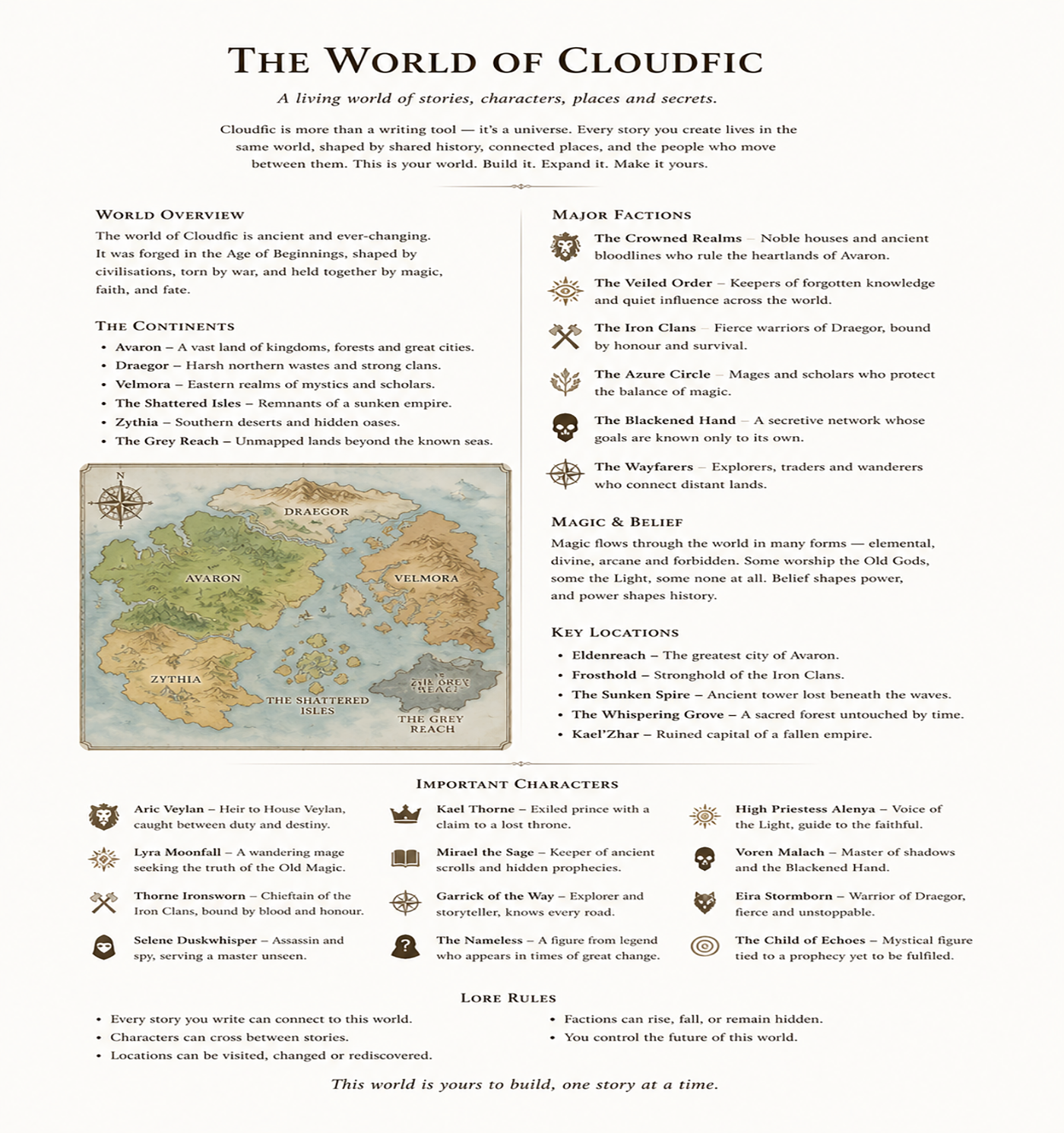
Worldbuilding is one of the most enjoyable parts of writing fiction. It is also one of the easiest places to lose weeks. Writers create maps, family trees, political systems, histories, religions, technologies, magical rules, character biographies and pages of notes. A fictional world can become enormous before the first chapter has properly begun.
But there is a problem. A world is only valuable to a novel if the manuscript can actually use it. A beautifully designed city that never affects a scene is decoration. A detailed political system that the writer cannot remember halfway through the book becomes a continuity problem. A character biography hidden in a separate document is not much help when Chapter 27 suddenly depends on something established six months earlier.
Worldbuilding should support the manuscript
Traditional writing software often splits a novel into completely separate jobs. You write the manuscript in one place. You keep character notes somewhere else. You store research in another document. You build a map in another application. You create a chapter outline in a spreadsheet.
Then, when you are actually writing a scene, you are expected to remember where everything is. That works until the book becomes complicated. A novel of 80,000 or 100,000 words may contain dozens of characters, locations, relationships, objects, rules, events and unanswered questions.
A world is only useful to a novel if the manuscript can actually use it.
Cloudfic approaches the problem differently. The world is not intended to sit beside the book as an encyclopedia. It is there to help the writer make better decisions inside the manuscript.
Start with the world itself
Every fictional world needs a foundation. That does not necessarily mean a continent, a magic system or a galactic empire. A contemporary crime novel has a world. A romance has a world. A family saga has a world. A psychological thriller has a world.
The important question is not how much lore can I create? It is what does the reader need to understand for this story to work? Cloudfic’s World Building Hub gives the writer somewhere to establish that foundation.
A World Overview can hold the central information behind the story — the place, atmosphere, culture, situation or premise that everything else grows from. For a fantasy novel that might include kingdoms, ancient conflicts or magical forces. For science fiction it might be the society, planet, colony or civilisation in which the story takes place. For a contemporary story it could be a town, school, workplace, neighbourhood or family environment.
People belong inside the world too
Worldbuilding is often described as geography. In fiction, people usually matter more. A city is memorable because of the people inside it. A kingdom matters because somebody wants the throne. A spaceship matters because somebody is trapped aboard it. A haunted house matters because someone refuses to leave.
Cloudfic therefore treats characters as part of the world rather than as disconnected notes. Character information can be organised into visual cards containing details such as role in the story, age, species where relevant, character overview, personality and important identifying information.
Character cards help prevent accidental drift
Characters change during a novel. They are supposed to. What writers generally do not want is accidental change. A cautious character suddenly becomes fearless because the writer forgot how they were originally written. A relationship becomes warmer or colder without the manuscript earning the transition.
Character cards give the writer a stable reference point. That becomes particularly useful when AI enters the writing process. AI can generate wonderfully convincing prose while still making assumptions that do not belong in your story.
Build the truths, laws and rules of the story
Some of the most important pieces of worldbuilding are not places or people. They are rules. Every story has them. Fantasy makes them obvious. But the same principle applies everywhere.
In a crime novel, who controls the investigation? What evidence exists? What can the police legally do? In science fiction, how fast can ships travel? What can artificial intelligence do? What happens when communication fails?
Cloudfic’s world structure gives those truths somewhere to live. That matters because rules create tension. If anything can happen at any time, very little matters.
Maps turn geography into story logic
Maps are another classic worldbuilding tool. They can also become pure decoration. The useful question is not whether a map looks beautiful. It is whether the map tells the writer something important about the story.
Where are the characters? How far apart are two locations? What lies between them? Could somebody realistically arrive there in time? What territory belongs to which faction?
Cloudfic allows maps to become part of the worldbuilding workspace rather than an unrelated file sitting elsewhere. That gives geography a practical role. A map can influence journeys, battles, meetings, escapes, discoveries and timelines.
Then connect the world to the chapters
This is where worldbuilding becomes particularly useful. A novel is not read as a database. It is read chapter by chapter. Whatever brilliant ideas exist in the author’s notes have to eventually pass through scenes.
That is why Cloudfic also uses Chapter Cards. The world describes what exists. The chapter cards help the writer decide when the reader experiences it. Chapter planning therefore becomes the bridge between world knowledge and reader knowledge.
Card View gives each chapter its own space
Looking at an entire novel as continuous text can make structural problems difficult to see. Chapter Cards create another perspective. Instead of thinking only in paragraphs and pages, the writer can look at the book as a sequence of story units.
Each chapter becomes something that can be considered individually. What happens here? Who appears? What changes? What does the reader learn? What has been set up? What still needs to happen?
Board View lets the writer step further back
Cloudfic’s chapter system can also move from Card View into Board View. That change of perspective matters. When writing Chapter 34, the writer is naturally concentrating on Chapter 34. Board View encourages another question: what is Chapter 34 doing inside the entire novel?
Suddenly the writer can think about rhythm rather than sentences. Perhaps five chapters in a row are dominated by exposition. Perhaps an important character disappears from the story for too long. Perhaps the climax arrives before enough pressure has accumulated.
The world and chapter board solve different problems
The World Building Hub answers: what is true about this story? Chapter Cards answer: where does the story happen? Board View answers: how is the story developing across the book? The manuscript answers: how does the reader experience it?
Put those together and the writer has something far more useful than a traditional folder of notes. They have multiple views of the same novel.
Cohesion comes from connections
Readers may never see the writer’s world notes. They still feel whether those notes exist. A cohesive novel has a particular quality. Things introduced early matter later. Characters behave as though they have histories. Locations feel connected.
That feeling does not normally come from adding more description. It comes from continuity. Cloudfic’s worldbuilding and planning tools are designed around helping the writer maintain those connections.
AI becomes more useful when there is already a story
AI is extraordinarily capable at creating possibilities. That is both its strength and its danger. Ask an AI to write a fantasy scene with no context and it can invent almost anything. The prose may sound perfectly convincing. The story may now be completely different.
The best use of AI inside a serious writing project is therefore not endless invention. It is invention inside boundaries. The writer creates the boundaries. The world establishes the facts. The characters establish personalities and relationships. The chapter structure establishes where the story is going.
Brainstorming becomes more focused
There is an enormous difference between asking what should happen next and asking what could happen next given this world, these characters and everything already established. The second question produces much more useful fiction.
Cloudfic’s AI tools can help the writer brainstorm scenes, developments and possibilities while the writer remains responsible for deciding what actually belongs in the novel. AI becomes a creative partner rather than a replacement author.
Writing the next chapter should not mean forgetting the previous thirty
One of the problems with generic AI writing is isolation. The writer supplies a prompt. The AI supplies some prose. But a novel is not a collection of unrelated prompts. Every new chapter inherits the entire book before it.
Cloudfic’s writing environment is built around treating the manuscript as a project rather than a single conversation. The AI is there to help continue your novel, not continually invent a new one.
The writer still makes the final decision
Cloudfic’s philosophy is not that every suggestion should automatically enter the manuscript. Quite the opposite. A useful writing tool should create possibilities that the writer can accept, reject, rewrite, adapt or ignore completely.
The manuscript belongs to the writer. That becomes particularly important during worldbuilding because fictional worlds contain deliberate ambiguity. Sometimes a contradiction is intentional. Sometimes a character is wrong. Sometimes the narrator is unreliable.
Worldbuilding can also expose plot holes early
Worldbuilding is often treated as something that happens before writing. In practice, it becomes increasingly useful after writing begins. Imagine establishing that the northern gate of a city closes every night at sunset. Twenty chapters later, a character casually rides through that gate at midnight.
That is a continuity error. But it may also reveal something more interesting. Perhaps the gate was deliberately left open. Perhaps somebody inside the city is helping them. Constraints are not the enemy of creativity. Very often they are the source of it.
Chapter cards can reveal forgotten promises
Writers make promises constantly. Not explicit promises. Narrative promises. A strange key appears. A character reacts oddly to a name. Someone refuses to enter a particular room. A photograph is missing.
Looking across chapters as cards or a board makes it easier to notice story elements that were introduced but never developed. That creates opportunities during revision. A forgotten detail can become a payoff. A missing payoff can be removed.
Worldbuilding is also useful during revision
Writers often imagine that worldbuilding ends when drafting begins. It does not. Revision is when many worlds become coherent. During a first draft, the writer discovers the story. Characters change. Locations change. Rules evolve.
The worldbuilding workspace then becomes a revision reference. What is canon now? What has changed? Which version of the character survived the draft? What rules does the finished book actually use?
The same system works for small worlds
Not every novel needs a continent. This matters because the word worldbuilding sometimes frightens writers away. They imagine fantasy maps and invented languages. But consider a locked-room mystery. Its world may consist of one hotel, twelve guests and a snowstorm.
A romance may revolve around two families and one coastal town. A thriller may take place almost entirely inside a technology company. A literary novel may focus on one house across three generations. Those are still worlds. They have geography. They have relationships. They have rules.
Keep planning close to the prose
There is another practical advantage to building these tools into the writing platform itself. Friction matters. Every time the writer leaves the manuscript, searches through folders, opens another application and hunts for a note, there is a small interruption.
Do that repeatedly and writing becomes administration. Cloudfic is built around reducing that gap. The manuscript, worldbuilding, project information, chapter planning and AI writing tools belong to the same creative environment.
The aim is not more information
This is perhaps the most important part. Cloudfic is not trying to persuade every writer to create enormous databases about their novels. More information does not automatically produce better fiction. The aim is useful information.
Information that helps the writer make decisions. Information that prevents continuity mistakes. Information that gives AI better boundaries. Information that helps reveal structural problems. Information that helps the writer return to a project after time away.
Build once. Use throughout the novel.
The strongest fictional worlds are rarely the ones containing the most facts. They are the ones where the facts matter. A location shapes a decision. A character’s history shapes a reaction. A law creates a problem. A political faction changes the stakes.
The reader may never see the machinery behind it. They simply feel that the story works. And that is ultimately what worldbuilding is for.
Not to create an encyclopedia. Not to delay writing indefinitely. But to give the story a reality sturdy enough for characters to live inside it.